Oct 11

BOSTON — The Red Sox were one strike away from a win that would have prolonged their season another day. But the Angels wouldn’t stand for it, coming up with three runs in the top of the ninth en route to a 7-6 victory that swept Boston out of the American League Division Series.

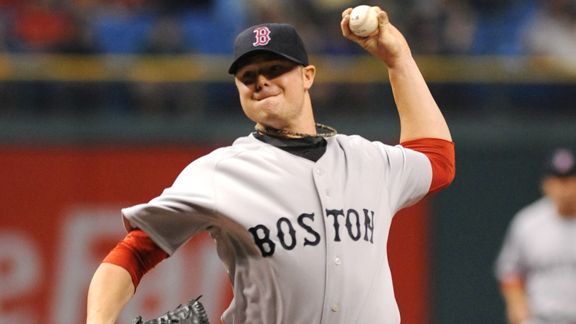
The victim of the jarring rally was closer Jonathan Papelbon, who entered Sunday never having allowed a run over 26 postseason innings. The Angels started their improbable rally with two outs and nobody on in the ninth. Erick Aybar laced a single up the middle. Chone Figgins worked a walk. Bobby Abreu brought the Angels within one on a double to left. The Red Sox walked Torii Hunter intentionally to load the bases for Vladimir Guerrero, and the star slugger delivered with a two-run single that gave the Angels their first lead of the day, silencing the Fenway faithful.

With some pep back in their offense, the Red Sox rode a two-run double by Dustin Pedroia and a two-run homer by J.D. Drew to a 5-1 lead through four innings against Angels starter Scott Kazmir.

Clay Buchholz performed well for Boston, allowing two runs over five-plus innings. The Angels got one back in the sixth, and two in the eighth to make it 5-4.

But Mike Lowell gave the Red Sox breathing room with an RBI single in the bottom of the eighth. As it turns out, it wasn’t enough breathing room.

The Red Sox entered the day 13-3 in potential elimination games under manager Terry Francona, and seemed primed to give themselves life again and force Game 4 on Monday night.

This time, however, it didn’t happen.

Tagged with:
Oct 08

The Boston Red Sox are quite familiar opponents for the Los Angeles Angels in the American League Division Series. However, all those previous matchups resulted in Red Sox series wins.

The key for the Red Sox this time is pitching. Jon Lester, who opens the series, has to keep guys off base, especially the guys who can run. Jacoby Ellsbury will be a key factor against Angels starter John Lackey. If Ellsbury gets on base, he’s going to steal. He will need to use his legs to create runs. Even though Lackey struggles against Boston, he has done some pretty good things in the postseason, including when he stepped up in 2002 and the Angels won the World Series.

Another important point the Red Sox must consider is to allow Lester to go deep in the game. That way, manager Terry Francona can mix and match his bullpen.

The key for the Angels is to focus on running. They have to get guys on base, from Chone Figgins to Erick Aybar to Bobby Abreu to Torii Hunter. They will have to make offence by taking the double play away from Lester, thus making him more concerned about the runners than he is about the hitter.

Keep in mind that Boston’s pitchers don’t keep runners close. They are very easy to run on. If you look at how the Angels played this year, that’s how they won a lot of games. They showed a lot more patience at the plate. Overall, their on-base percentage is higher than it’s ever been, but they ran, and that’s what they will have to do to beat Boston. If the Angels try to sit back and outscore Boston, they will fail because the Red Sox just have too much firepower in the middle of their lineup. The Angels will have to run and run and run. If they make it a track meet, they will beat the Red Sox.

Lackey and Josh Beckett are capable of demoralising a team, and it’s unclear whether the Angels have that shutdown pitcher to counter it.

If Victor Martinez or Jason Varitek can handle those baserunners, it’s over. In other words, if the Red Sox can beat the Angels with one of their weaknesses, there’s nothing Los Angeles can do.

The first game is in Anaheim, but that won’t make a difference. The Angels have yet to prove they can beat the Red Sox. If Boston jumps out early, for example, let’s say Ellsbury leads off with a hit, steals a base and scores a run – don’t be surprised if some of the L.A. players look at each other and say, “Oh no, here they come.”

Tagged with:
Oct 08

They will come out firing, these Red Sox will, and hope that their stacked line of power pitchers will lead to another lengthy postseason run.

It starts with the co-aces at the top of the rotation in Jon Lester and Josh Beckett, who both sit in the mid-90s with their heat and have secondary pitches that make the fastballs look faster. Clay Buchholz, the blossoming No. 3 starter, also relies on his heater, though he mixes in a plus curveball and changeup.

And when it comes time for manager Terry Francona to go to the bullpen, the Red Sox have a heat-heat-heat finish trio of Billy Wagner, Daniel Bard and, yes, closer Jonathan Papelbon, who has never allowed a run in 16 career postseason outings.

On those chilly October nights of recent years, high-octane gas has often led to championship glory. The Red Sox hope that will be the case for them, beginning with their best-of-five American League Division Series against the Angels.

“I think it’s proven that [power arms] are a successful type of pitcher that has done well in the postseason,” said Red Sox pitching coach John Farrell. “If you look back at recent teams that have won or gone deep in the postseason, there’s been a reliance on power-type arms. That’s not to say that you can’t win with a mixture of styles.

“On the flip side of that, Hideki [Okajima] has been extremely successful and been outstanding in the two postseasons prior to this season. I think what it ultimately comes down to is you have to consistently get hitters out with stuff inside the strike zone.”

But stuff inside the strike zone is more difficult to hit when it is traveling faster.

Veteran third baseman Mike Lowell has two World Series rings (2003 Marlins and ‘07 Red Sox) that were won largely on the strength of power pitching.

“Not to take anything away from those finesse pitchers, but if that day, you don’t have your great stuff, your power arms seem to be able to get away with a little more,” said Lowell. “No matter what, it’s hard to hit 95 [mph] unless you’re throwing it down the middle. But I think there’s a little more leeway for a guy with a power arm to battle through a couple of innings where he doesn’t have sharp stuff and make an adjustment, than a guy who doesn’t have velocity, who might get touched up pretty early.”

Boston’s power-packed staff is especially vital against an Angels team that must be limited as much as possible, or else they will turn baseball games into track meets.

The Angels finished third in the AL with 148 stolen bases.

“If you don’t let anyone on, you don’t really have that issue,” said Red Sox catcher Jason Varitek. “I think if we pitch the ball well, we’ll be OK. I think that that’s the most important thing — is that we throw the ball well. We’ve played them — we understand that they take the extra base. We understand that they have guys who will put pressure on the outfielders and trying to take the extra bases and run. It’s something that we should be prepared for.”

The Angels have used the same running style in years past, only to be eliminated by the Red Sox in the 2004, ‘07 and ‘08 ALDS. The reason, in all three cases, is that the Red Sox’s staff was dominant.

They have the horses to do so again. Lester, who didn’t allow the Angels an earned run in two starts in last year’s ALDS, takes the ball in Game 1. Beckett, with the exception of last year when he was hindered by an oblique injury, has dominated postseasons past. This is Buchholz’s first crack at October, but he will try to calm his nerves with his electric stuff.

“What sets the tone is starting pitching, and we have a pretty good threesome we can throw out there,” said Varitek. “We have two horses at the front. That bodes well.”

But in the postseason, it always seems to come down just as much to bullpens, and the Red Sox have a good one. Papelbon has been an All-Star all four seasons he’s been in the Majors and his fastball looks faster than the radar gun readings because of the explosion at the end. Bard throws 100 at times, and sits between 97 and 99. Wagner, even after Tommy John elbow ligament replacement surgery, still hums it in there in the mid-90s.

Are a collection of power arms a big advantage in October?

“It only helps if you throw third strikes and get people out,” Wagner said. “But we’ve got a lot of talent. It’s a luxury to have.”

Has Wagner ever been part of such a loaded staff?

“Not quite as deep as these guys. This is about as good as it gets, I believe,” said the 38-year-old lefty.

With 1,230 strikeouts, the Red Sox finished second in the AL this season. Against the Angels, the ability to miss bats comes in handy for the simple fact that when they make contact, they immediately put pressure on the defense.

What can the Red Sox do when the Angels do reach base?

“From a pitcher’s standpoint, we’ve got to learn to control that tempo and be unpredictable from an unloading or a holding of the ball standpoint, to not fall into any type of predictable patterns in terms of the time elapsed to the time a pitcher comes set to when he first makes his move to deliver the ball to home plate,” Farrell said. “We’re well aware of their style of play. I wouldn’t solely put their style of play just on the running game. They’re a much deeper, much more powerful lineup than maybe ones we’ve faced before. We have the utmost respect for their capabilities and we’ll be prepared to deal with that.”

Deal is exactly what Boston’s pitchers plan on doing.

“We have some guys that can dial it up a little bit, and I think because of that, your margin for error is a little bit greater than the finesse guys,” said Red Sox left fielder Jason Bay. “During the playoffs, your margin for error is less. You don’t have that luxury of having that one bad start or two. Luckily for us, we have some good power guys.”


Tagged with:
Oct 07

The Powerhouse Postseason is here

Yankees. Dodgers. Cardinals. Angels. Red Sox. Phillies. Rockies. Twins.

It is a field stacked with playoff experience, stacked with strong frontline starting pitchers, stacked with explosive offense, stacked with managers who have been here before — and stacked with a combined winning percentage that usually translates into long series.

The Division Series begins with Rockies at Phillies at 2:37 p.m. ET on Wednesday, followed at 6:07 p.m. ET by Twins at Yankees, followed at 9:37 p.m. ET by Cardinals at Dodgers. The Red Sox-Angels opener will be at 9:37 p.m. ET Thursday.

Four advance to the League Championship Series, which begins Oct. 15 in the National League and Oct. 16 in American League, and then the 105th World Series gets under way on Oct. 28. If there is a World Series Game 7 it would be on Nov. 5, the latest end to any Major League Baseball season, and it just might go that far.

The combined records of the eight postseason clubs in this regular season was 753-544, culminating with the tiebreaker victory on Tuesday night. That is a winning percentage of .581, the highest for any postseason field since .593 in 2004. The winning percentage was .574 in 2008, .566 in 2007, .569 in 2006 and .575 in 2005.

If you look those last four seasons before this one, then you can associate those lower overall regular-season winning percentages with postseasons that featured quicker, often lopsided series. They never yielded more than 32 total playoff games (32 in 2008, 28 in 2007, 30 in 2006 and 30 in 2005). Two years ago, there were three sweeps (Rockies over Phillies, D-backs over Cubs and Red Sox over Angels) — and one that made it to four games (Indians over Yankees).

Earlier this decade, long series seemed to be the rule for a while, and you can associate that period with stronger overall winning percentages by the postseason fields. Look at the years from 2001-04. They were seasons of higher regular season winning percentages: .593 in 2004, .588 in 2003, .612 in 2002 and .595 in 2001. They yielded more than 34 total playoff games every season (34 in 2004, 38 in 2003, 34 in 2002 and 35 in 2001).

Just three of the 21 postseason series over the last three years went the distance. Those three were each an LCS, one per year that went the distance. A Division Series has not gone the full five games since the Angels eliminated the Yankees in 2005. A World Series has not gone the full seven since the Angels beat the Giants in 2002.

If you like best-of-five series that go four or five games, and best-of-seven series that finish with one of those often-historic and always suspense filled Game Seven’s, then you may be in for a treat. Based on that, one certainly can correlate strong postseason fields with lengthier postseason series. And there are even more reasons than that to see why it is tough to visualize any of these clubs going down without a protracted fight in 2009.

“The teams in this field areĀ great teams,” said Hall of Famer Cal Ripken Jr. “They all have their strengths, so I think the matchups will be interesting. It’s not about how you get there, because it is a whole new world once you get to the playoffs.”

Postseason experience is another big reason these matchups all could go either way. There are no Cinderellas in these ballclubs, no wide-eyed newbies. There are individual players who are here for the first time, of course, but every team has a nucleus that knows what this is about, and there is by far more combined postseason experience among the eight managers than in any postseason before. That can play a key role in October (and November).

Recent years have featured the “new-look” charm of clubs that were unique to many postseason viewers. The Rays saw their first postseason last year and the Brewers were in it for the first time since 1982. Colorado’s postseason appearance in 2007 was a first since 1995 and its first trip to the Fall Classic. The Tigers’ 2006 run to the World Series was a first sight for fans in their early 20s, and 2005 was that year Houston fans finally got to see what a World Series felt like — even if it was short-lived during the White Sox sweep.

In the AL, the Yankees are back from a meager one-year hiatus, following a streak of postseason appearances dating back to the Pleistocene. Mike Scioscia’s Angels won it all in 2002, and this is their fifth visit since. For Boston, which just happens to play in the same division as the team with baseball’s best record, it’s time for a sixth postseason in the last seven years — and the hope of a third ring in that span. Minnesota won the World Series in 1987 and again in 1991. Their last trip to the postseason was in 2006 after winning the AL Central, just as they have done this season.

In the NL, the Dodgers are in the postseason for the fourth time in the last six years, with old October hands like Joe Torre, Manny Ramirez, Juan Pierre and Casey Blake. Tony La Russa’s Cardinals are in it for the seventh time this decade, having won it all in 2006. The Phillies are NL East champs a third year in a row and have a great chance to repeat as world champs. The Rockies were a World Series newbie in 2007, when they went on that historic late tear before being swept by Boston, and now everyone knows that Troy Tulowitzki, Brad Hawpe, Todd Helton and the other purple-clad warriors have the ammo.

The playoffs are not played on paper. If they were, then the great 1969 Orioles rotation never would have let the Mets be Amazin’; Charlie Root would have walked Babe Ruth before surrendering the Called Shot; Dennis Eckersley would not have located that last slider to Kirk Gibson elsewhere; and Evan Longoria and the Rays would not have lost their dome-field advantage last year against the Phillies.

But on paper, it is easy to envision a 2009 postseason replete with games and series that go the distance, and a 105th World Series that is stretched to the limit. Based on all of this — combined with some amazing 1-2-3 pitching combinations and the presence of loaded lineups like those of the Yankees (club record for season homers) and Phillies (four with 30 or more homers) — it has all the makings of a Powerhouse Postseason.

The field is set, and what a field it is.

My 2009 Play-off Predictions

National League Division – Philadelphia Phillies

American League Division – New York Yankees

World Series Champions – New York Yankees (in 5 games)

Tagged with:
preload preload preload